Influence: The Psychology of Persuasion PDF

Click on the DOWNLOAD button below to download the book Influence: The Psychology of Persuasion PDF, written by Robert Cialdini, for free.
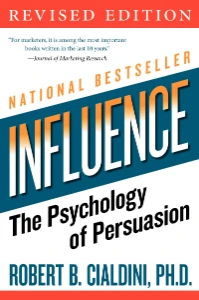
Influence: The Psychology of Persuasion PDF Free Download

WriterRobert Cialdini
CategorySelf Development
LanguageEnglish
PublisherHarperCollins
Publish Date2009
Pages278
File Size2 MB
File TypePDF

I can admit it freely now. All my life, I’ve been a patsy. For as long as I can recall, I’ve been an easy mark for the pitches of peddlers, fundraisers, and operators of one sort or another. True, only some of these people have had dishonorable motives. The others—representatives of certain charitable agencies, for instance—have had the best of intentions.

Influence: The Psychology of Persuasion PDF

No matter. With personally disquieting frequency, I have always found myself in possession of unwanted magazine subscriptions or tickets to the sanitation workers’ ball. Probably this long-standing status as a sucker accounts for my interest in the study of compliance: Just what are the factors that cause one person to say yes to another person? Influence: The Psychology of Persuasion PDF

And which techniques most effectively use these factors to bring about such compliance? I wondered why it is that a request stated in a certain way will be rejected, while a request that asks for the same favor in a slightly different fashion will be successful. So in my role as an experimental social psychologist, I began to do research into the psychology of compliance.

At first, the research took the form of experiments performed, for the most part, in my laboratory and on college students. I wanted to find out which psychological principles influence the tendency to comply with a request. Right now, psychologists know quite a bit about these principles—what they are and how they work.

Influence: The Psychology of Persuasion PDF

I have characterized such principles as weapons of influence and will report on some of the most important in the upcoming chapters. After a time, though, I began to realize that the experimental work, while necessary, wasn’t enough. It didn’t allow me to judge the importance of the principles in the world beyond the psychology building and the campus where I was examining them.

It became clear that if I was to understand the psychològy of compliance fully, I would need to broaden my scope of investigation. I would need to look to the compliance professionals—the people who had been using the principles on me all my life. They know what works and what doesn’t; the law of survival of the fittest assures it. Influence: The Psychology of Persuasion PDF

Their business is to make us comply, and their livelihoods depend on it. Those who don’t know how to get people to say yes soon fall away; those who do, stay and flourish. Of course, the compliance professionals aren’t the only ones who know about and use these principles to help them get their way.

Influence: The Psychology of Persuasion PDF

We all employ them and fall victim to them, to some degree, in our daily interactions with neighbors, friends, lovers, and offspring. But the compliance practitioners have much more than a vague and amateurish understanding of what works than the rest of us do. As I thought about it, I knew that they represented the richest vein of information about compliance available to me. Influence: The Psychology of Persuasion PDF

For nearly three years, then, I combined my experimental studies with a decidedly more entertaining program of systematic immersion into the world of compliance professionals—sales operators, fund-raisers, recruiters, advertisers, and others. The purpose was to observe, from the inside, the techniques and strategies most commonly and effectively used by a broad range of compliance practitioners.

That program of observation sometimes took the form of interviews with the practitioners themselves and sometimes with the natural enemies (for example, police buncosquad officers, consumer agencies) of certain of the practitioners. At other times, it involved an intensive examination of the written materials by which compliance techniques are passed down from one generation to another—sales manuals and the like.

Influence: The Psychology of Persuasion PDF

Most frequently, though, it has taken the form of participant observation. Participant observation is a research approach in which the researcher becomes a spy of sorts. With a disguised identity and intent, the investigator infiltrates the setting of interest and becomes a full-fledged vi / Influence participant in the group to be studied.

So when I wanted to learn about the compliance tactics of encyclopedia (or vacuum-cleaner, or portrait-photography, or dance-lesson) sales organizations, I would answer a newspaper ad for sales trainees and have them teach me their methods. Using similar but not identical approaches, I was able to penetrate advertising, public relations, and fund-raising agencies to examine their techniques. Influence: The Psychology of Persuasion PDF

Much of the evidence presented in this book, then, comes from my experience posing as a compliance professional, or aspiring professional, in a large variety of organizations dedicated to getting us to say yes. One aspect of what I learned in these three years of participant observation was most instructive.

Influence: The Psychology of Persuasion PDF

Although there are thousands of different tactics that compliance practitioners employ to produce yes, the majority fall within six basic categories. Each of these categories is governed by a fundamental psychological principle that directs human behavior and, in so doing, gives the tactics their power. The book is organized around these six principles, one per chapter.

The principles—consistency, reciprocation, social proof, authority, liking, and scarcity—are each discussed in terms of their function in society and in terms of how their enormous force can be commissioned by a compliance professional who deftly incorporates them into requests for purchases, donations, concessions, votes, assent, etc.

It is worthy of note that I have not included among the six principles the simple rule of material self-interest—that people want to get the most and pay the least for their choices. This omission does not stem from any perception on my part that the desire to maximize benefits and minimize costs is unimportant in driving our decisions. Nor does it come from any evidence I have that compliance professionals ignore the power of this rule.

Influence: The Psychology of Persuasion PDF

Download More Books

Getting Past Your Past PDF – Francine Shapiro

Getting to Yes PDF – Roger Fisher, William Ury

Why We Sleep PDF – Matthew Walker

How to Be A Stoic PDF – Massimo Pigliucci

What Color Is Your Parachute PDF – Richard Nelson Bolles